Nothing f##ks you harder than time.
Game of Thrones
Photo by Scott Robinson – (https://flickr.com/photos/clearlyambiguous/27211012)
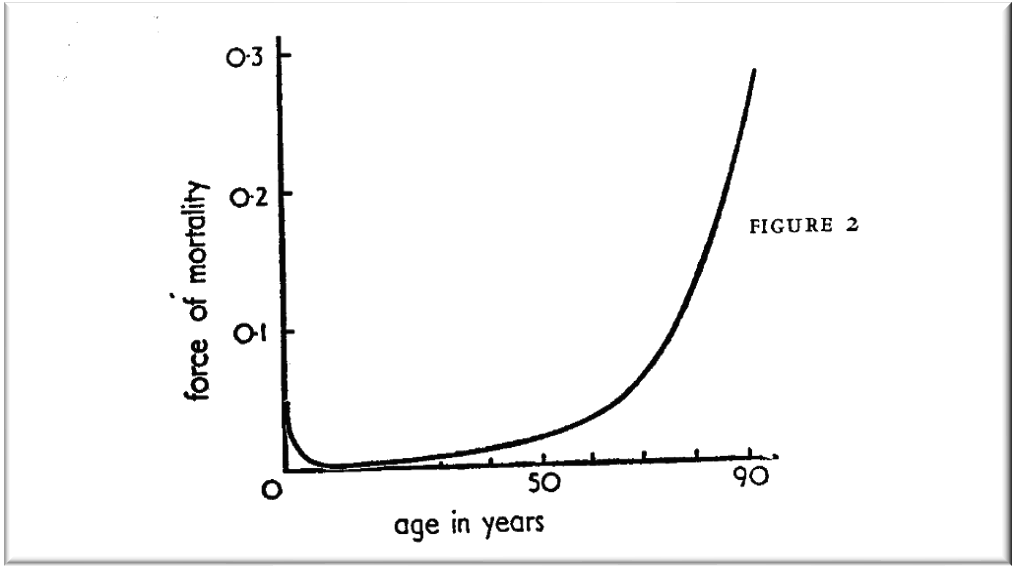
Passage of time leaves its physical trace on our body. It’s a universal phenomenon that organisms age and senesce due to the effect of time. Aging and senescence are two different concepts. Aging refers to the mere accumulation of years to the life of an animal. Senescence is the progressive and irreversible decline in the vitality and vigor that happens with aging. Some animals could just age and not senesce. Greenland shark could live for more than 400 years and it’s body won’t deteriorate with time. The situation is not the same for humans and other mammals. Time accelerates our death drive. After a certain age, our body progressively loses the sturdiness to withstand injury or stress and the risk of death increases exponentially. There is a mathematical pattern to the change in this risk over time. It is very high immediately after birth due to the vulnerabilities of infancy. Then it steadily decreases to reach a point of lowest risk during periods of reproductive maturity. A plateau ensues following this and after the age of 40 or 50, there is an exponential rise in the risk of death. It doubles every 7 to 8 years.
This process is so much a part of our life that we never question it but accept as a fundamental nature of life. What causes our body to decline as we age? Is it possible to stay youthful forever? Can ‘aging related death’ become an option? I am well aware of existence of few absolute impossibilities in reality. It is impossible to create or destroy energy-mass (Conservation laws) or to create a machine that generates work with 100% efficiency (Laws of thermodynamics). Does aging belong to the realm of biological laws of impossibilities? But, I also strongly believe in a sweet little rule – There is always something more to do. We are only limited by how much we know. Impossibilities will always exist and the realm of possibilities will always continue to expand.
We are mere explorers of infinity in the pursuit of absolute perfection
G.H. Hardy
How is senescence and death interlinked? Do human really die ‘naturally’ from old age or is it erroneous to say ‘died from old age’? This question is better understood if life and death are conceptualized differently. Typically death is seen as an unexpected event that happens during life. However, death is actually the natural ground state and life is, in fact, a privileged state that always carries within itself a strong natural tendency to return back to the ground state. Thus, death is not an accident, it is a propensity. Senescence is the progressive decay in the sturdiness of the privileged state, making the return to the ground state of death easier during events that could happen during the flow of life.
Let’s get our definitions clear before we attempt to gather deeper insights into this process.
Phases of life
I sleep with life and death in the same bed
Bob Dylan
There are five phases in life
Birth is an event when the first-cell forms by the fusion of an egg and sperm. This first-cell carries all the knowledge needed to form a mature organism when adequate material and energy are provided.
Growth is a process during which cells increase in number, organs get bigger and the organism grows up in size to attain maturity.
Youth is a period of steady state during which the random damages that occur are near perfectly matched by repair mechanisms resulting in preservation of the organism.
Senescence is a continuous process of progressive decline in the vigor and ability of the body to preserve its structure and flow of energy. It gradually takes the body towards death with time.
Death is an event in which the coherent functioning of organ systems fail and the organism loses its ability to flow energy. The organism will spontaneously dismantle itself to its elements following this event.
To understand human aging we need to break down our body into individual elements. We are fundamentally made of atoms like every thing else in the universe. These atoms of carbon, hydrogen, nitrogen and oxygen join with each other and form molecules of variety of shapes and forms. Trillions of molecules cooperate to form the most sophisticated structure called Cell. Trillions of cells cooperate to form the next levels of organization – organ and then human body. Where does aging or decay begin and progress in this structural and functional hierarchy of an organism? Is it at the atomic level or at a level above it?
Molecular aging
Receive with humility. Fight sensibly. Let it go gracefully.
Marcus Aurelius (modified)
Do atoms and molecules in our body undergo changes over time and contribute to initiation or progression of aging? I am not a physicist, but I am pretty sure that stable atoms, in general, are immortal. We are predominately made up of stable atoms and they were formed billions of years ago in some far away stars. Over these many years they have not changed in their shape or form in any obvious ways. So they should not be changing during the life span of an organism. However, our body also carries unstable atoms within its structure. The unstable atoms are the ones that decay over time. We have plenty of Carbon – 14 and Potassium- 40 in our structural make-up. Imagine what would happen when a Carbon -14 in the DNA of a brain cell spontaneously decays and disrupts the DNA structure. I would expect a significant domino effect. Apparently during one’s lifetime, around 50 billion C-14 decays occur within human DNA! I don’t know how we even exist in spite of these molecular explosions within the code-script. At that rate I would expect our body to be studded with cancerous cells on a daily basis. Thanks to the repair mechanisms that subdue this effect. Also the atoms in our body are constantly recycled. Molecules break down, gets purged out and new molecules are created using fresh set of atoms from the air we breathe and the food we eat. The atom that is part of my body today will probably belong to a worm or a bird next week. Only the pattern of organization of atoms remains more or less constant but the building blocks are continuously recycled.
In conclusion, atoms don’t age, they are continuously recycled, and unstable atoms in our body constantly try to collapse our integrity.
Cellular Senescence
Cells form the next layer in the organizational hierarchy of human body. Previously it was thought that cells don’t age and they are immortal like the atoms. It was believed that the cells divide into daughter cells and that every time they divide it maintains the vitality. Later it was proved that healthy cells are only capable of a limited number of divisions. It is partly due to the fact that a fraction of DNA does not get copied during each replicative cycle and its content gets progressively smaller. Eventually it reaches a point where it can not replicate any further. Hence in general, cells age with time and then it eventually dies.
Cells are an active enterprise that continuously process energy and generate work. It has a powerhouse that generates useable form of energy from food. There is a data center that has instructions to accomplish all of its activities. It is as busy as a human city with efficient nanobots doing all the chores. Hence atoms are the structural unit and Cells are the functional unit of the body. Over time this functional unit accumulates error in reproducing the data, carrying out the instructions from the data, building abnormal molecules that accumulate, nanobots that are dysfunctional and a structure that is fragile – In short they age. But cells have been in existence for over 3 billion years and it has acquired mechanisms to counteract this effect by evolution. Errors in DNA replication can be corrected and abnormal proteins can be removed before they could form molecular machines.
There are immortal cell lines that can multiply continuously and maintain the vigor. Cancer cells and certain types of genetic mutations give cell the capacity to multiply rapidly and indefinitely. However, though these cell lines can divide continuously they do not have the identity or order that exists in healthy mortal cells. They accumulate mutations as they divide and the daughter cells may not have much resemblance to the parent cells. So these rogue cells may not age but they change so much that the parent line can be considered to be dead.
Conclusion, cells age and die. But it has robust repair mechanisms which also eventually succumbs to time. If they don’t age and die then they mutate, become deviant and incapable of maintaining any higher level of organization.
Senescence of Organs
An organ is a complex organization of different types of cells working in synchrony to produce a set of functions. Heart is an organ that pumps the blood and lung is an organ that take up oxygen from air and loads it in blood. Organs are extremely sophisticated structures. For example, the human heart beats about 100,000 times in a day and pumps about 2000 gallons of blood everyday. During the lifetime, it pumps about a few billion times before it stops.
Everyone of us must have personally experienced the changes associated with an aging organ. Aging skin is the most obvious. Lungs attain the maximum capacity at around 25 years of age and then it continues to lose about 25-30 ml of air every year for rest of the life. The vitality of an organ greatly depends upon the health of each and every cell and it’s ability to co operate. These cells are held together in a precise three-dimensional structure by specialized supporting proteins. Unfortunately this delicate and complex network of cells and proteins that support them are prone to wear and tear with time. The cells become less vigor, the structure loses its physical properties and the organization (organ) gradually loses its function.
Aging human body
Senility is an artifact of domestication
Peter Medawar
If you notice carefully as we climb up in this hierarchy we observe an interesting phenomenon. The atoms that are static in form for billions of years associate with each other and build highly dynamic networks. When an atom was a free folk, it was battered repeatedly by the molecular storm of heat and it wandered aimlessly. Once it is incorporated in the organization of molecules, cells, organ or organism it becomes part of a system performing directed work using energy. These structures are capable of performing variety of functions including highly sophisticated ones like wanting to go to the moon or crave for a cold beer.
Aging and death are only applicable to higher organizations but not to the building blocks. Atoms are ageless – But molecules break, cells lyse, organs weaken and organisms age, die and reorganize.
The human body is a cooperative network of various organ systems. Each organ loses its vitality at a different rate. The cardiovascular system, consisting of the heart and blood vessels, is the first to age and fail. ‘Natural death’ does not occur due to the aging of the lungs, kidneys, liver, or skin. Even at 100 years old, these organs could still function normally, albeit with diminished vitality. However, the heart and blood vessels would have aged sufficiently to fail before the centenary celebration.
Not so wise
To avoid aging, the individual parts of our body must be recycled and refreshed continuously otherwise the body will be corroded by the natural elements within a short period of time like other non-living things. The process of replacing the molecules and cells with new ones maintains the youthfulness of the organism. Thus the body must remain dynamic and should keep hitting refresh button to prevent corrosion, yet the overall structure and form should remain static and exact same. This is possible only when the knowledge to build the structure is intact but the material that goes into the construction is replaced. This is like an obsessive builder who is sitting inside a house and does constant repair. To maintain the integrity of the house, the builder replaces few bricks every day with a new set of bricks. In this way the overall structure is always maintained new. However it only last as long as the builder has the knowledge to build the house. Once he loses his memory or after he dies the house will begin to disintegrate. Similarly with time a key aspect of our life crumble and this process of recycling cannot continue indefinitely. The key aspect is the ‘evolutionary knowledge’ that was present in the ‘First cell’. A knowledge that was accumulated by trial and error over billion years of evolution – The accurate three-dimensional arrangement of trillions of atoms in the First cell. This knowledge that was present in our First cell is capable of building the human body by taking in the material and energy from the environment. With every successive replication of the cell, errors creep into the knowledge and the daughter cells are not as wise as the mother cell. Before the knowledge could be permanently lost and while the body is still in its prime health, the sperm cell and the egg cell from the human body passes the intact knowledge to the next generation of life, and in this way the knowledge continues to survive in the species while the individual withers away with time.
Cooperation and coherence
In addition to possessing the knowledge to perform functions like producing chemicals (insulin), generating electricity (brain), transferring materials (kidney) or generating force (muscle), the cellular machinery also has the knowledge to cooperate and act in coherence with other cells.
Cooperation is a trait in which the individual cells invest in behaviors that are costly to themselves but benefit the organization. The cells have the higher knowledge to understand that fitness of an individual cell depends on the survival of the organism.
Both types of knowledge were acquired over 3 billion years of cellular evolution. The first set of functional knowledge was predominantly acquired during evolution of unicellular life like bacteria or yeast. The evolution of multicellular organisms like animals and trees endowed cells with cooperative knowledge. Every human cell carries an accurate and comprehensive details of all the knowledge that was acquired by life over 3 billion years. Our cells are very similar in structure and function to a bacterium or yeast. A small amount of changes in some of the molecules decides whether the first cell is going to become a bacterium, chicken or human.
Cellular senescence is characterized by both loss of function and cooperation. Cells become weak and cancerous. Cancer cells are rogue cells that have lost the understanding of usefulness of organization. This usually happens due to changes in the data center (Genome or epigenome). They go about independently trying to establish a less organized state and eventually both the organism and the cancer would die with the collapse of the superstructure.
Aging is the most significant risk factor for cancer development. It is much more potent than cigarette smoking and alcohol put together in causing cancer. In fact aging is the most important risk factor for almost all type of human diseases including heart attack, stroke, diabetes or hypertension. It is the major cause of death of any domesticated organism!
Ancient war between Biology and Physics
Every living moment must pay a death tax
Firstly, aging is not a genetic process and there is no gene or group of genes in our body that actively instruct people to wind down with time. Our ‘First cell’ was programmed to last forever. We don’t have any clock inside of us that is ticking away. It is the ‘nature’ inside and outside of us that is gradually chipping us away. Aging is a gradual phenotypic change due to progressive drift in our genetic (and epigenetic) knowledge. It is an outward expression of an ongoing mortal combat between the laws of physics and biological organization. Physical laws are unyielding in nature and get an unswerving universal obedience. Knowledge is biology’s strength. During the growth phase of life, the tiny molecular machines(enzymes and proteins) extract ‘order’ from the world around and the organism grows in size. Senescence is a physical process in which chaos eventually consumes order with time. We see it everywhere, things naturally tend to disorder. This natural phenomenon is described as the second law of thermodynamics. Knowledge and continuous work output are needed to sustain any orderly structure.
The cellular knowledge and the work it performs hold the system against time for a certain period. Eventually it succumbs once the knowledge is irreversibly lost. The advancing human knowledge about this order might further prolong this ancient fight against the tide of time.
Researchers who have been diligently working against aging were able to identify genes and molecules that constantly do the work of repairing the genomic and the epigenomic changes that cause aging. Simple measures such as stress of fasting and exercise boosts the efficacy of these repair bots and keep the knowledge and hence the order intact for a longer period. In the future we may be able to tweak this whole system by adding molecules like the way we thwarted small pox and lot of the infectious diseases and cancers!
Yes, aging can be treated and death can be delayed or even conquered. There is always something more to do… we are only limited by how much we know. There is always something more to know.. we are only limited by how much we can imagine.
Nurture your mind with great thoughts, for you will never go any higher than you think
Benjamin Disraeli
Aging ‘Self’
What effects does aging have on our mental life? Is there such a thing as psychological senescence? What does time do to our affect, capacity to dream, will, desire and our cognition? The effects are probably broad and profound and it could even make all other ideas discussed so far insignificant. Our psychological ‘Self’ dies and resurrects innumerable number of times during our lifespan. It is delusional to connect all the pieces of ‘our’ physical-self together and imagine as one coherent line of history. Drawing a line to define where and when ‘I’ ends and the ‘Rest’ begins is an assumption that we are forced to make for the sake of building an operational reality.
The butterfly counts not months but moments, and has time enough
Rabindranath Tagore
References:
1. Lifespan: Why we age and why we don’t have to. David A Sinclair and Mathew D. LaPlante. Atria Books. Sept 2019.
2. Intercellular competition and inevitability of multicellular aging. Paul Nelson and Joanna Masel. PNAS. Dec 2017.
3. Information and knowledge in biology: time for reappraisal. L Kovac. Plant signal Behav. March 2007.
4. Life’s Ratchet: How molecular machines extract order from chaos. Peter M. Hoffmann.
5. Physics makes aging inevitable, not biology. Peter M. Hoffman.
6. An unsolved problem of biology. Peter Medawar 1951.

 sureshmanickavel.com
Very well written, Suresh! Enjoyed reading it. Look forward to more such write-ups.
LikeLiked by 1 person
Thank you, Dr. Anand! I enjoyed writing this piece.
LikeLike
Nice Article Suresh! Very well written..
LikeLiked by 1 person
Thank you!
LikeLike